
AI search visibility now depends on brand authority and multi-platform presence. This is how business owners earn citations in AI search.
For 20 years, digital marketing followed one rule: rank first on Google, collect the traffic, convert the visitor. That model is closing fast. AI search visibility is replacing it, and the businesses that understand the difference are already pulling ahead of competitors who are still optimizing for an architecture that has effectively been replaced.
If you run a business, this shift decides whether AI systems recommend you or leave you out of the answer.
Search Is No Longer a Click Game
The data is not subtle. According to SparkToro’s 2024 zero-click study, built on clickstream data from Datos, 58.5% of U.S. Google searches end without a click to any external website. In the European Union, that figure is 59.7%. Search Engine Land tracked the monthly acceleration, reporting that the U.S. zero-click rate climbed from 24.4% in March 2024 to 27.2% in March 2025, while organic click-through rates fell from 44.2% to 40.3% over the same window.
Then there is the AI layer sitting on top. Conductor’s analysis of 21.9 million Google searches found AI Overviews on 25.11% of them between mid-September and mid-October 2025. Semrush’s AI Overviews study shows how quickly that layer arrived: AI Overviews appeared on 6.49% of queries in January 2025, peaked at 24.61% in July, and stood at 15.69% in November.
The truly unsettling number for business owners: Pew Research reported in July 2025 that users clicked a link inside Google’s AI summary in just 1% of visits to pages that showed one. The traffic model that built the last two decades of digital marketing is mostly unavailable, because users are getting their answers inside the interface.
Visibility must be measured by whether your content provides the synthesized answer, not by whether it generates a click.
What a Citation Economy Actually Means
Here is the shift in plain language. The search result page used to be a list of doors. You optimized your door to appear near the top, and traffic walked through. The new search result page is a finished answer built from specific sources the AI decided to trust. Those sources get cited inside the answer, and every business left out is functionally invisible.
The traffic was absorbed into the answer. Simple, broad queries now resolve entirely inside the interface because AI systems can handle them. Complex, multivariable queries still require outside expertise, and that is the ground where business owners compete now. Depth, nuance, and real-world authority are the differentiators, because surface-level content is already automated.
This changes what success looks like. In the citation economy, you compete to be selected as a trusted source inside an AI-generated response.
AI Search Visibility Explained As Infographic
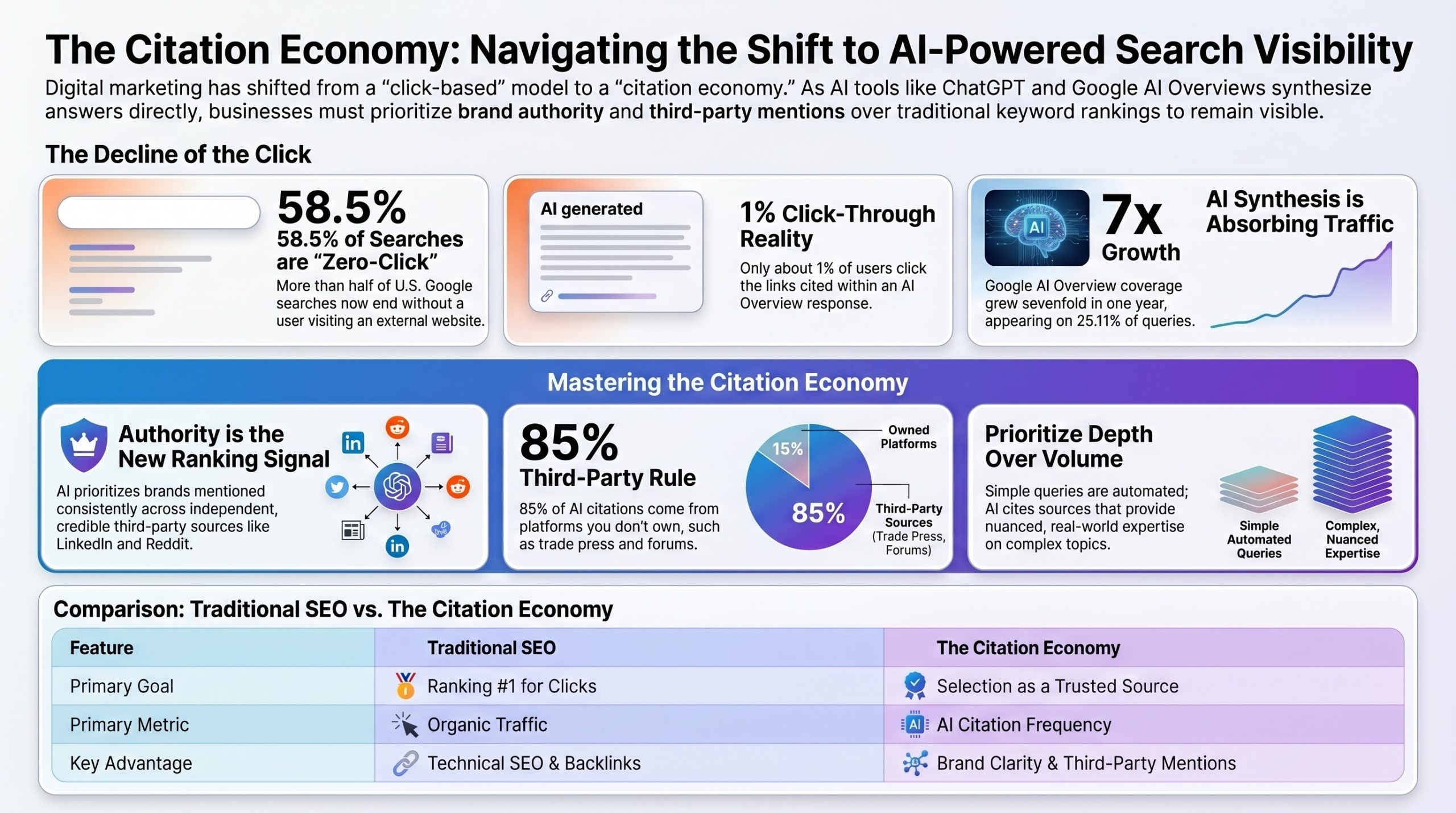
Why Brand Authority Is the New Ranking Signal
Most business owners hear “AI search” or “GEO builds on SEO, it doesn’t replace it” and assume the fix is technical. Technical SEO and backlinks remain necessary, but they have been downgraded from competitive advantage to minimum requirement for entry, and brand-level authority has become the differentiator.
The research on AI Search Visibility backs this up. Ahrefs’ study of 75,000 brands found that branded web mentions show a 0.664 correlation with brand visibility in Google’s AI Overviews, the strongest of any factor it measured. Branded search volume came in at 0.392. Domain Rating, the traditional link-based authority metric, showed a weaker correlation of 0.326. Seer Interactive’s 2025 analysis reached a similar conclusion: traditional SEO strength showed little correlation with brand mentions inside AI answers.
Translation: given a choice between the site with the most backlinks and the brand that shows up repeatedly and credibly across the places their training and retrieval sources sample, AI systems favor the brand. That is a brand clarity problem before it is a content problem.
If your brand is inconsistent or invisible across the wider web, no amount of on-site optimization will rescue you. Clarity first. Content second. Technical third.
Software now reads your site alongside people. AI agents, the tools that research products and draft vendor shortlists on a buyer’s behalf, compare you with competitors in seconds. In our view, what they can use is clear positioning, machine-readable data, third-party validation and current information, and brand authority is what tells an agent you belong on the shortlist.
How Do AI Systems Decide Which Brands to Cite?
In our experience, three things decide which brands belong in an answer:
-
Consistent presence across multiple independent sources
-
Recognition from credible third parties (industry publications, review platforms, community forums)
-
Historical credibility built through repeated, accurate mentions over time
The distribution of citations reveals why this matters. An AirOps analysis of more than 21,000 brand mentions in answers from GPT-5, Claude, and Perplexity found that 85% of brand mentions came from third-party domains, most of them listicles, comparisons, and reviews. Only 13.2% came from the brand’s own domain. In other words, most of your AI visibility is being built on platforms you do not own.
The practical takeaway: you build AI search visibility by being present, recognized, and recent across the ecosystem your buyers use, including the large share of it you do not own.
What AI Systems Are Actually Looking For on Your Site
On your own site, these are the signals we work on first, whether an AI system is writing an answer or building a shortlist.
-
Structured data. Schema markup and JSON-LD give search engines explicit clues about the meaning of a page: what you sell, who it is for, where you operate. Google says no special schema is required for its AI features, so treat markup as support for clear pages, not a substitute for them.
-
Clarity over cleverness. Clear, machine-readable information beats brand storytelling. What do you offer? Who is it for? What does it cost? How does it work? If the answers are buried five paragraphs deep, the system moves on.
-
Accessibility infrastructure. This part is easy to miss. ARIA tags, clean HTML, proper heading hierarchy, and descriptive labels were originally built to make sites usable for people with disabilities. Those same signals now help AI read your site. OpenAI says its ChatGPT Atlas browser uses ARIA tags, the same labels and roles that support screen readers, to interpret page structure and interactive elements. In our view, that gives sites already built for accessibility a head start with AI.
-
Connection points. Where it fits your business, we expect data feeds and structured endpoints to matter more over time. Availability, inventory or scheduling that an agent can read cleanly is easier to use than details buried in a homepage.
-
Freshness. Keep key pages current and dated. Ahrefs found that AI assistants tend to cite fresher content than Google’s organic results do.
Build Presence Beyond Your Website
Discovery is no longer centralized. Your potential customers are asking questions on ChatGPT, Gemini, Perplexity, Claude, and Google AI Mode. They are researching on LinkedIn, YouTube, Reddit, and industry forums. They are reading reviews on G2, Capterra, and Trustpilot. Each of these environments runs its own recommendation layer that samples a different slice of the web.
A single-platform strategy will not survive this. The businesses that win are building what we call a presence-driven strategy: a coordinated, consistent footprint across every environment where authority gets validated. That means:
-
A clear, authoritative presence on your own website, structured so AI can extract it cleanly
-
Active participation in the industry publications and review platforms your customers already trust
-
Useful contribution, without promotion, to community spaces like LinkedIn, Reddit, and industry forums
-
Consistent brand descriptions, positioning, and categorization everywhere your company appears
-
Original research, data, or perspectives that other people cite, because citations compound
Inconsistent information across these environments is a brand clarity problem. When AI retrieves conflicting descriptions of what you do or who you serve, it either gets the answer wrong or picks a competitor whose story is clearer.
What Business Owners Should Do This Quarter
If you run a business and want to be in AI-generated answers six months from now, start here:
-
Audit your current AI visibility. Run your 10 most important buyer queries through ChatGPT, Gemini, Perplexity, and Google AI Overviews. Note where you appear, where competitors appear, and where nobody from your category is cited at all.
-
Tighten your brand clarity. If an AI system cannot describe your business in one clear sentence, customers cannot either. Get the positioning clean before scaling content.
-
Publish content with real depth. Original data, firsthand expertise, specific answers to specific questions.
-
Treat accessibility and structured data as commercial infrastructure. Schema markup, clean HTML, and ARIA tags help AI systems read your site.
-
Expand beyond your website. Guest contributions, industry publications, thoughtful community participation, authentic review platform presence. This is where AirOps found 85% of AI brand mentions originate.
-
Refresh regularly. Update high-value pages on a defined cadence. Ahrefs found that AI assistants tend to cite fresher content than Google’s organic results do.
This is a compounding system that runs well past a 90-day sprint. In our view, the businesses that start building it now are the ones AI answers will name a year from now.
Ready to Build AI Search Visibility That Lasts?
When your brand is clear, your authority is visible across the platforms your buyers use, and your content is structured for citation, visibility follows.
For a clear-eyed look at where your business stands in the citation economy and a strategy for moving forward, Request an Engagement.