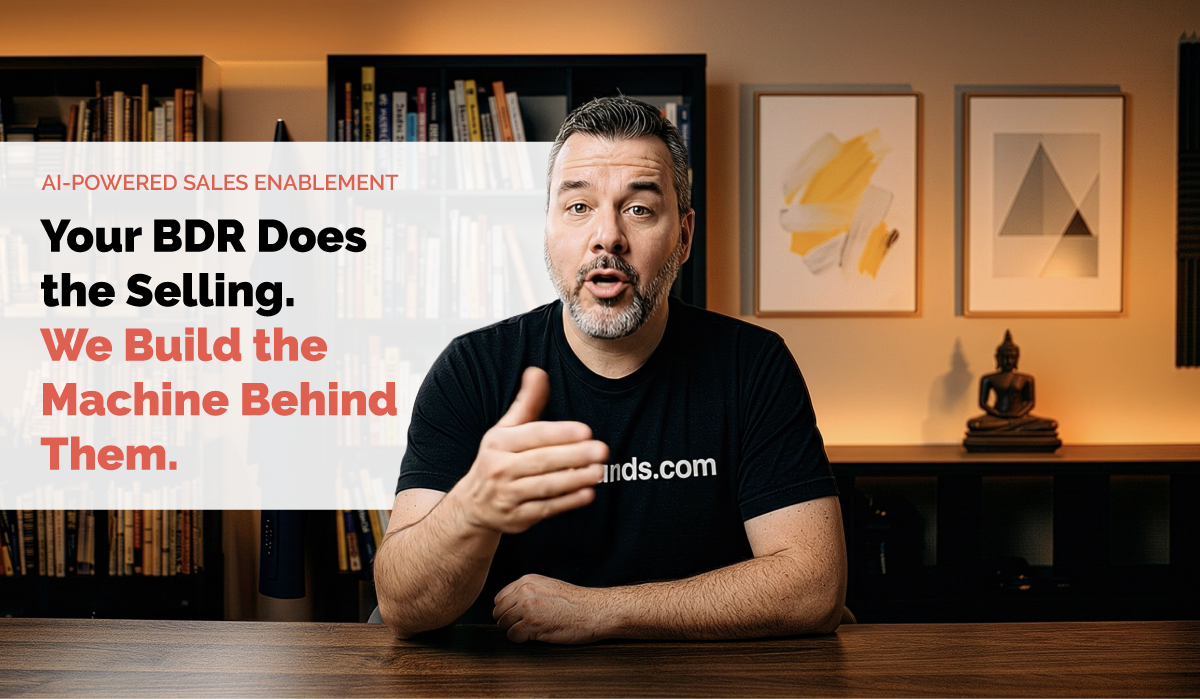
If your BDR is burning hours on research, writing, and manual follow-up before they ever get to an actual conversation, you do not have a rep problem. You have an infrastructure problem. AI outbound sales enablement is the system that fixes it. Not by replacing your sales rep, but by building intelligent automation around them so they can spend their time where it actually matters: the conversations that close deals.This post covers what an AI outbound sales enablement system looks like, why it outperforms traditional outbound on three dimensions simultaneously, and who it is actually built for.
Why Traditional Outbound Is a Process Problem, Not a People Problem
The standard BDR workflow was not designed for the volume and personalization that modern B2B buying requires. Research a prospect. Track down their contact information. Write a personalized email. Follow up three times. Log everything in the CRM. Move to the next one. Do that eighty times a day, at a quality level that actually converts.
It does not work. Not because your reps are not capable, but because the BDR function is shifting away from volume-based outreach toward precision engagement, and manual workflows cannot keep up with that shift. The research alone can consume three or more hours before a rep makes their first call of the day.
Adding more headcount does not solve this. It scales a broken process. The fix is better infrastructure behind the rep you already have, and that is exactly what an AI outbound sales enablement system provides.
Outbound Sales Enablement
What AI Outbound Sales Enablement Actually Delivers
AI outbound sales enablement is a managed system, not a tool you install and forget. It is the combination of platform architecture, ICP targeting, sequence strategy, and ongoing optimization that allows your sales rep to operate at an output level that would otherwise require two or three people.
Understanding what the AI layer handles makes the value clear:
-
Prospect research and enrichment: Pulling firmographic data, job titles, buying intent signals, and verified contact information automatically, without manual list building or database scrubbing
-
Personalized outreach copy: Drafting emails and LinkedIn messages tailored to each prospect’s specific industry, role, company context, and known pain points. This is not mail-merge personalization. It is genuinely contextual messaging built from real data signals
-
Sequence timing and follow-up: Triggering the right touch at the right interval based on actual engagement behavior, not a fixed calendar that treats every prospect the same
-
Lead scoring and prioritization: Surfacing the highest-intent accounts first so your rep calls the right person at the moment they are most likely to respond
-
CRM logging and activity capture: Recording interactions automatically so manual data entry does not consume an hour at the end of every day
The rep handles the relationship. The discovery call. The negotiation. The close. Everything that requires a human who can read a room, build trust, and adapt in real time. The system handles everything that does not require that.
Buyer Personalization
Why Does Buyer Personalization Matter More Than Volume?
Because 73% of B2B buyers actively avoid sellers who send irrelevant outreach. Not ignore. Avoid. Generic sequences do not just underperform. In niche B2B markets where your prospects all know each other, they actively damage your brand reputation with the exact accounts you need to reach.
The AI-driven personalization built into a well-architected outbound system pulls from real signals: company hiring activity, technology stack changes, LinkedIn engagement patterns, recent funding announcements, and industry-specific triggers. The result is copy that reads like it was written specifically for one person, because the underlying research was pulled specifically for that person.
There is also a compounding effect over time. As the AI outbound sales enablement system learns which message angles, subject lines, and sequence structures perform best in your specific market, it improves. A well-maintained outbound system in month twelve outperforms itself in month one by a significant margin. That improvement does not happen with a static template library or a manual process that depends on individual rep effort.
The teams winning with AI outbound are not blasting more emails. They are sending fewer, better ones to a more precisely targeted list, and converting at meaningfully higher rates.
How To Improve Outcomes
Three Things That Improve at the Same Time
The case for AI outbound sales enablement is unusual because it improves speed, cost, and targeting accuracy simultaneously. That combination almost never comes from a single investment.
Speed
Prospect lists that would take a full day to build and enrich can be generated in minutes. A five-touch, multi-channel sequence that would take an afternoon to write, personalize, and schedule can be drafted, reviewed, and deployed in under an hour. Your rep arrives every morning with a prioritized list already prepared, sequences already queued, and yesterday’s CRM activity already logged. Selling time increases from day one.
Cost
The unit economics shift significantly. Instead of hiring a second BDR to increase output, you invest in a system that multiplies the output of your existing rep. Tooling and setup costs are a fraction of the fully loaded cost of additional headcount, which includes salary, benefits, equipment, ramp time, and ongoing management overhead. McKinsey research shows companies investing in AI-driven personalization see 5 to 15% revenue lift, with top performers achieving up to 25%. Those returns are not achievable through headcount additions alone.
Accuracy
ICP targeting sharpens over time. Buying signals replace static lists. Outreach copy is built from real-time data, not templates written six months ago. The result is higher reply rates, better-qualified meetings, and a pipeline that actually reflects your ideal customer profile rather than everyone who happened to match a job title filter.
From Small & Mid to Enterprise
Is This Only for Large Sales Teams?
No, and this is one of the most persistent misconceptions about AI outbound sales enablement. The system is arguably more impactful for small and mid-market B2B teams than for enterprise organizations with fifty-person sales floors. A single-rep shop benefits more from infrastructure that multiplies their output than a large team that can absorb inefficiency through raw volume.
The platforms that power AI outbound sales enablement are accessible at any scale. Clay handles orchestration and enrichment. Purpose-built sending infrastructure manages deliverability. AI APIs generate and refine sequence copy. None of this requires an enterprise contract or a dedicated RevOps team to operate. The barrier is not budget. It is knowing how to architect and connect the pieces so they function as a coherent system rather than a pile of disconnected tools with no strategy behind them.
Managed Partner vs Tool Stack
What a Managed Partner Brings That a Tool Stack Cannot
Access to the tools is not the hard part. Every sales team can buy a subscription to Apollo, Clay, or a dozen other platforms. What most teams cannot do internally is build an AI outbound sales enablement system correctly, define the ICP precisely enough to make the targeting work, write sequences that actually convert in their specific vertical, and continuously optimize based on what the performance data is telling them.
A partner who specializes in B2B sales prospecting automation handles the full stack. They define your Ideal Customer Profile. They write and test the sequences. They build the content library your rep uses for follow-up. They monitor reply rates, diagnose what is underperforming, adjust the messaging, and deliver a clear performance report every quarter. The system keeps improving because someone who knows how to read the data is watching it.
That ongoing management is what separates a one-time automation build, which degrades quickly in niche markets where messaging gets stale and prospects recognize repetition, from a managed system that compounds value over time and stays sharp as your market evolves.
Build Window is Narrowing
The Window to Build This Advantage Is Narrowing
62% of BDR teams now use AI tools, up from 53% the previous year. The teams building these systems now are establishing a structural advantage that becomes harder to close every quarter. Once AI-powered outbound is the standard expectation rather than a differentiator, the first-mover advantage disappears.
The question is not whether AI changes how outbound sales works. It already has. The question is whether you invest in AI outbound sales enablement now or spend the next year trying to close a compounding gap against competitors who started earlier.
Ready to Build Your AI Outbound Sales Enablement System?
We design, build, and manage AI outbound sales enablement systems for B2B teams. That means ICP definition, sequence strategy, enrichment and automation architecture, and ongoing quarterly optimization based on real performance data. If your BDR is working hard and the pipeline is not reflecting that effort, the infrastructure is the problem. We fix the infrastructure.